Conservation & Restoration · 2025
Bricklehampton Hall
Conserving Historic Plaster Work Within a Grade II Listed Italianate Villa
01
The Building
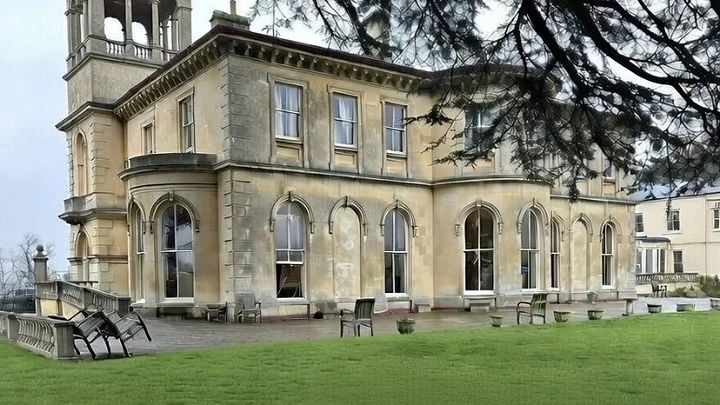
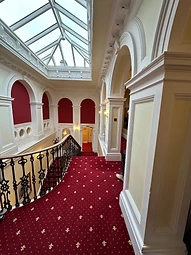
Built in 1848 for the Woodward family, Bricklehampton Hall is a Grade II listed Italianate villa set within the Worcestershire countryside. Richly detailed decorative plaster work forms an important part of the building's historic character, with ornate cornices, ceiling enrichments and mouldings contributing to the scale and elegance of its principal rooms.
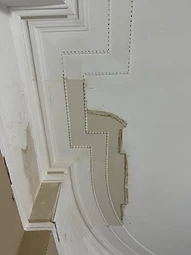
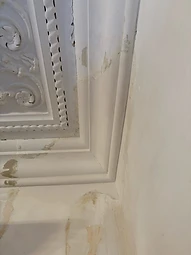
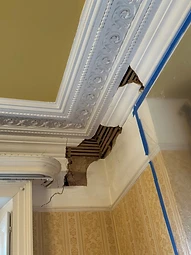
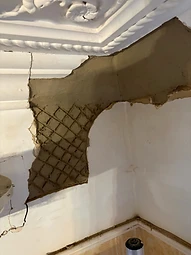
Over many years, persistent water ingress had resulted in the deterioration of several decorative ceilings. Repeated saturation had caused areas of traditional lime plaster to fail, leaving mouldings unstable and sections of ornament missing. The challenge was not simply to repair the damage, but to conserve as much of the original craftsmanship as possible whilst returning the affected rooms to a sound condition for continued use.
02
Our Approach
Every room was carefully assessed to establish the extent of the deterioration and to distinguish original fabric from previous repairs. Working closely with the client, the restoration strategy was developed around the principle of retaining historic material wherever practical.
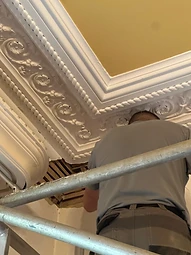
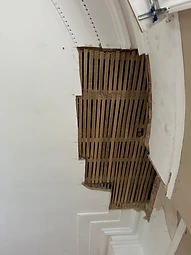
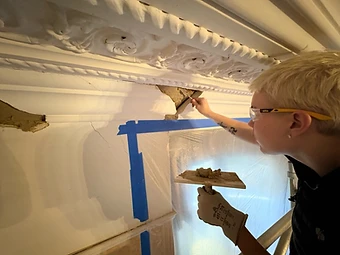
Unstable plaster mouldings were carefully removed and recorded before failed backgrounds were cut back to sound material. Where necessary, deteriorated timber grounds and timber laths were replaced to provide a secure base for the reinstatement of the decorative plaster work.
Traditional materials were used throughout, including a blend of non-hydraulic lime and plaster of Paris with carefully graded washed sand and natural fibres to reproduce the characteristics of the original work.
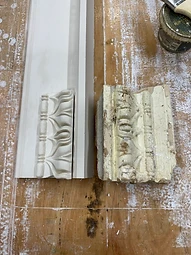
Surviving decorative enrichments were used to produce squeezes and moulds from which replacement sections could be run and cast. Each new element was manufactured to match the original profiles before being carefully fitted and blended into the existing work, allowing the repairs to sit naturally alongside the historic fabric.




03
The Outcome
The conservation works successfully restored the decorative plaster work across several rooms, stabilising the ceilings whilst preserving the architectural character of the original interiors. By combining traditional craftsmanship with a careful conservation approach, the project retained the maximum amount of historic fabric while accurately reproducing those elements that had been lost.
Bricklehampton Hall continues to serve its present-day function whilst retaining the decorative qualities that define this important nineteenth-century building. The project reflects Classic Plasterwork's approach to conservation, understanding the building first, intervening only where necessary, and ensuring that every repair respects the craftsmanship of the original makers.